
Is Your Portrait of a Graduate Missing This Critical Piece?
Dec 01, 2025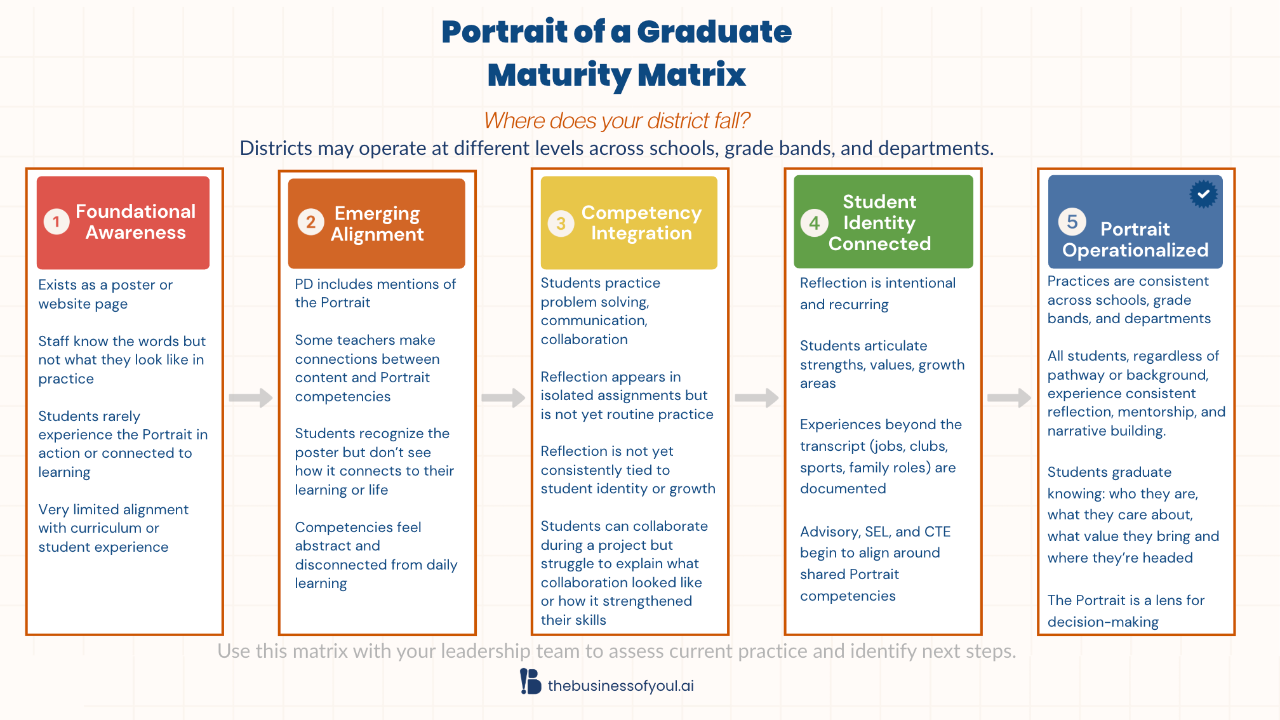
We're Teaching All the Right Skills - But We Must Connect Them to Students' Lives
Over the past few years, the Portrait of a Graduate has become the North Star for how schools define readiness. It defines the traits students should have when they cross the stage at graduation.
Most portraits feature the same familiar words: Communicator. Collaborator. Critical Thinker. Lifelong Learner.
They’re the right words. Educators believe in them. Parents love them. Employers desperately want them.
But in a world being rewritten by AI, automation, and uncertainty, a new question is emerging: Are these portraits enough?
Families aren’t asking because they doubt their schools. They’re asking because they’re watching the world change faster than curriculum cycles. They’re wondering whether their children will be ready for a future no one can fully define.
Here’s the truth: The challenge isn’t that schools teach the wrong things. It’s that we haven’t consistently connected what students learn to who they are becoming.
We see it everywhere: in classrooms, at kitchen tables, and especially during college-essay and job interview season, when parents spend thousands of dollars for someone to help their children articulate what school never explicitly asked them to say:
Here’s who I am. Here’s what I stand for. Here’s what I bring. Here’s where I’m going.
That’s the piece schools are being asked to strengthen now. It's the bridge between skills and identity.
Until that connection becomes routine, all the posters of the portraits in the world won’t prepare students for what comes next.
We’re Teaching the Right Things … Just in Pieces
Schools already teach what the future demands. The problem isn’t what’s being taught, it’s that the pieces often live in separate silos.
- In English, students learn communication, but not how to use that communication to tell their own story.
- In social studies, they explore leadership and systems, but do not always connect those ideas to their own communities.
- In math, they build logic and problem solving, but still ask the classic question everyone remembers: “When will I ever use this?”
- In science, they learn inquiry, but not always how curiosity shapes their personal growth.
The dots are there. Now the opportunity is to help students connect them consistently.
Because we’re graduating students who know a great deal. But they can’t always explain what they know about themselves.
This matters. Research highlighted in Harvard Business Review shows that self-awareness is strongly linked to better decision-making, stronger relationships, and higher leadership effectiveness. Leaders who are more self-aware are consistently rated as more successful and more promotable than their peers. (Harvard Business Review). And it’s the one skill the future can’t automate.
So here’s the question for every school:
Where do students practice connecting their learning to their identity?
The World Changed. Our Portrait Must.
AI can analyze, summarize, and optimize faster than any human. The premium skills of the next decade are distinctly human:
- self-awareness
- adaptability
- curiosity
- connection
- communication
- leadership
The National Bureau of Economic Research found that these durable (or soft) skills are more predictive of long-term success than technical knowledge. Yet nearly 90 percent of employers struggle to find graduates with these traits.
It’s not because schools aren’t trying. It’s because we still measure the skills that AI can now do better.
The next chapter in readiness requires schools to put visibility and intentionality behind the human traits that matter most.
The New Divide: Access and Agency
Families are already responding to the gap.
Private college advisors, essay coaches, and career consultants now cost between $2,000 and $10,000 per student. This is not for content tutoring, it is for teaching kids to articulate who they are.
That’s the new inequity emerging in education.
Students in well-resourced communities are essentially buying connection. They are paying for someone to help them translate what they’ve learned into a coherent personal story.
Meanwhile, the average school counselor or career coach supports more than 350 students. No one person can scale identity-building alone.
This isn’t about asking educators to do more. It’s about weaving reflection, storytelling, and meaning-making into the practices schools already do best.
So the real question becomes:
How do we make identity-building accessible to every student, not only those who can afford it?
The Next Wave: Schools That Are Getting It Right
Across the country, districts are moving beyond the portrait poster. They are not doing this by reinventing school, but by re-humanizing it.
Here’s what they’re doing differently:
1. They treat reflection as a skill, not an afterthought.
Students don’t just submit assignments. They articulate what those assignments reveal about their strengths, values, and growth.
District reflection prompt: Where in your current schedule do students practice reflection in a structured, recurring way?
2. They make mentorship visible.
Teachers already mentor students every day. These districts simply make it intentional.
Every student builds a “board of advisors” made up of peers, teachers, coaches, and community members who challenge and champion them.
District reflection prompt: Who, beyond classroom teachers, is helping each student feel known, supported, and seen?
3. They teach students to translate learning into language.
Instead of listing achievements, students learn to describe who they are becoming with evidence from across subjects, extracurriculars, jobs, and lived experiences.
This doesn’t require a new curriculum, just a shared practice.
District reflection prompt: Have teachers been trained to help students translate experiences into strengths they can name and use?
4. They measure what matters.
Not grades for grit or empathy, but opportunities for students to self-assess collaboration, resilience, creativity, communication, and growth.
When you walk through these schools, you see something different: students who are practicing being human, not just compliant.
Districts that do this are attracting families, energizing staff, and retaining talent.
District reflection prompt: What opportunities exist for students to assess and discuss their growth in the competencies in the Portrait of a Graduate?
Parents, This Is Your Moment Too
Parents don’t need to storm school board meetings. But they can elevate the conversation by asking sharper questions:
- Where do students learn to connect what they learn to who they are?
- How do we help them talk about their strengths beyond grades?
- If we say we value collaboration and empathy, where do students actually practice those?
And at home, parents can build identity in minutes, not mandates:
- Once a week, ask: What did you learn about yourself?
- After an activity, ask: What strength did you use today?
- At dinner, rotate who shares a growth moment.
- Before bed, ask: Where did you surprise yourself today?
Because the answer to “When will I ever use this?” shouldn’t be “on the test.” It should be:
“Every time you tell your story."
What’s Next for Schools
This is the moment to evolve the Portrait of a Graduate from a vision to a practice.
The future-ready districts won’t just teach communication, collaboration, and critical thinking. They’ll help students practice those traits in personal, meaningful ways.
- Reflection becomes routine.
- Mentorship becomes culture.
- Self-awareness becomes readiness.
The next evolution in education won’t come from more content, but from deeper connection.
Because readiness isn’t a checklist. It’s a practice.
The world doesn’t need graduates who can memorize, measure, and move on. It needs humans who can connect, communicate, and contribute.
That’s how we prepare students not just to graduate but to become who they are meant to be.
As districts work to bring their Portraits to life, one question keeps coming up: How do we know where we are today and what the next step should be?
That’s where a clear framework helps. Not as a judgment, but as a roadmap. A way for leaders to reflect, align, and move forward with intention. That’s why districts are asking for a clearer way to understand where they are now and what the next step looks like.
The Portrait of a Graduate Maturity Model offers five levels of practice (from poster to lived experience) and helps districts identify where they are and where they want to go next.
Portrait of a Graduate Maturity Matrix
A diagnostic lens for district leadership
Level 1: Foundational Awareness
Definition: The district has an approved Portrait and district-wide graphic.
- Exists as a poster or website page
- Staff know the words but not what they look like in practice
- Students rarely experience the Portrait in action or connected to learning
- Very limited alignment with curriculum or student experience
Level 2: Emerging Alignment
Definition: Staff understand the competencies and occasionally reference them.
- PD includes mentions of the Portrait
- Some teachers make connections between content and Portrait competencies
- Students recognize the poster but don’t see how it connects to their learning or life
- Competencies feel abstract and disconnected from daily learning
Level 3: Competency Integration
Definition: Portrait skills are embedded into instruction...as skills, not identity.
- Students practice problem solving, communication, collaboration
- Reflection appears in isolated assignments but is not yet routine practice
- Reflection is not yet consistently tied to student identity or growth
- Students can collaborate during a project but struggle to explain what collaboration looked like or how it strengthened their skills
Gap: Students can demonstrate skills but cannot yet explain how those skills show up in their own lives.
Level 4: Student Identity Connected
Definition: Students begin linking the Portrait to their personal story.
- Reflection is intentional and recurring
- Students articulate strengths, values, growth areas
- Experiences beyond the transcript (jobs, clubs, sports, family roles) are documented
- Advisory, SEL, and CTE begin to align around shared Portrait competencies
What’s still missing: Students’ stories are emerging but not yet cohesive or confidently expressed.
Level 5: Portrait Operationalized
Definition: The Portrait is operationalized at the student level.
- Practices are consistent across schools, grade bands, and departments
- All students, regardless of pathway or background, experience consistent reflection, mentorship, and narrative building.
- Students graduate knowing: who they are, what they care about, what value they bring and where they’re headed
- The Portrait is a lens for decision-making
This is where education is heading. A Portrait that is lived, not laminated.
Stay connected with news and updates!
Join our mailing list to receive the latest news and updates from our team.
Don't worry, your information will not be shared.
We hate SPAM. We will never sell your information, for any reason.
